
How to Specify Thermal Retention for a Vacuum Flask
By Lin Haoran, Thermal & Vacuum Furnace Engineer · Updated
Quick answer
Prepare a thermal test brief for the exact flask, cap and capacity you plan to order.
Start with the moment the flask has to work
The meaningful target for an outdoor vacuum flask is a temperature at a specific time under a defined set of conditions. A hiker who pours coffee after six hours, an overland group opening a flask several times, and a crew taking one drink at the end of a shift are asking for different performance.
Choose the smallest realistic fill, a plausible starting temperature, a realistic ambient temperature, and whether the closure will be opened. Decide when the user actually needs a useful drink, then agree the measurement point with the supplier.
A buyer specifying an eight-hour unopened test for an expedition model can also ask for a separate repeated-pour profile. Record both under different names so a strong result in the closed test cannot obscure the behavior of the flask in use.
What should purchasing put in the initial brief?
During a review of actual use, suppose the buyer needs a camp flask that serves four pours between lunch and dusk. Ask for a pour schedule, smallest expected fill, and useful endpoint temperature. Watch for this risk: a closed-cap result is used to answer a repeated-access question.
Start by writing the buying decision in one sentence and sharing it with the supplier before asking for a sample. Include who will use the product and under what conditions. If several models are under consideration, give each its own line and identify which assumptions the models share. Ask the supplier to return any exceptions in writing so the sample team can focus on the decisions still open.
Control the starting conditions before comparing samples
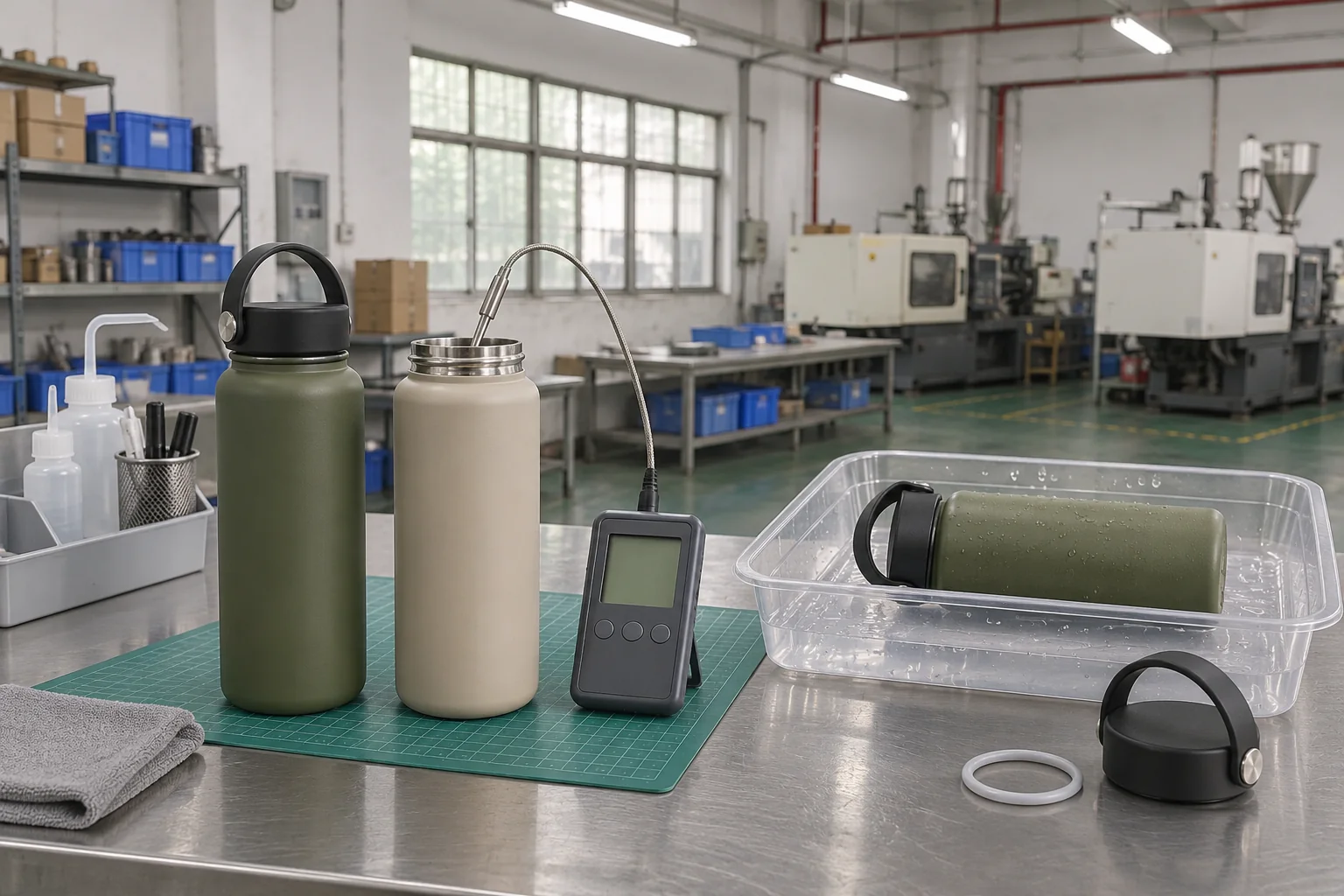
Temperature curves reflect the sample and the procedure. Transfer time from kettle to bottle, water mass, cap tightening, and preheating can change results even when two samples have the same construction.
Set a common transfer method and define time zero. Record the actual fill mass, water temperature at time zero, closure installation, and ambient temperature across the run. If the buyer expects a cold vessel at the start, condition all samples together before filling.
Run a separately labeled preheated scenario if the user instructions recommend it. For a supplier comparison, the presence of a conditioning step matters as much as the temperatures because it changes the initial heat that the liner absorbs.
What makes two proposals comparable?
During a review of test setup, suppose two testers start timing at different points in filling the flask. Ask for one definition of time zero, water mass and ambient logs. Watch for this risk: a preparation difference becomes a claimed insulation advantage.
Use the same quantity, delivery assumptions and version of the specification when soliciting alternatives. Ask each supplier to identify which details are included in their proposal and which would require separate development or testing. Save the assumptions alongside the quote. Once someone updates a sample or an input, record the resulting revision so the whole team is comparing proposals from the same round.
Understand what the vacuum and copper can change
An evacuated gap limits heat transfer through the gas in the space between the vessels. Radiation across that space, conduction through joints, and heat flow through the neck and closure can all remain important. Copper-colored finishes visible on the outside tell the buyer little about the thermal construction.
Ask whether the proposed surface treatment faces the evacuated gap, where it is applied, and whether any change is isolated to the reflective surface. Compare matched samples that share the same body geometry, fill, production-intent closure, and test conditions.
Treat a claimed improvement as a hypothesis until the matched comparison comes back. If the cap, neck or production batch also differs, use the result to select the better assembled flask and reserve any attribution to copper for a controlled comparison.
Which details should the supplier explain?
During a review of copper comparison, suppose a copper-treatment option is quoted alongside a revised neck design. Ask for matched assemblies with only the reflective treatment varied. Watch for this risk: the buyer attributes an assembly-level result to one surface change.
Ask the supplier to identify what they can verify directly and what depends on a component partner, independent laboratory or carrier. Put names on the tasks and request the relevant evidence before the decision date. Keep supplier statements next to the supporting records so that a reviewer can distinguish a design proposal from an observation on a particular sample or shipment.
Separate closure effects from body effects
Wide mouths reduce friction during cleaning and pouring. A small cap assembly may have less exposed area, while a stopper with a pour channel introduces a different heat path and a different experience outdoors. The configuration the customer receives governs the relevant performance.
Keep cap and gasket revisions on the sample sheet. If a supplier proposes a revised cap, compare it on matching bodies and run a seepage and usability check separately. Include handling with gloves and the ability to reinstall the gasket where this fits the use case.
A buyer may receive an impressive test on a solid transport plug and later select a cup lid with a pour-through stopper. The first curve remains informative about that assembly, while the new selling configuration needs its own curve before packaging is printed.
What should the sample review confirm?
During a review of cap revision, suppose the product team adds a pour-through stopper after seeing an impressive test report. Ask for the exact production-intent stopper, gasket and matching body. Watch for this risk: packaging repeats a number obtained with the prototype closure.
Agree the review location, conditions and timing with the people who will approve the result. Document what was reviewed as well as any deviation introduced during preparation, and make the sample or images available to purchasing, quality and product staff. Where an issue can be reproduced, retain the setup and sequence so a second person can check the observation before approval.
Choose the checkpoints and the acceptance rule
A useful report records the initial temperature and a small set of decision points. Repeated openings to take readings can alter the curve, so specify a suitable logging setup or use separate sealed samples for destructive endpoint readings.
Decide how many units will be checked, whether every unit must meet the minimum, and how an invalid run is handled. Save the sensor identification, its calibration status, the sample IDs, and any deviations alongside the readings.
As a hypothetical comparison, samples starting at 95°C that finish at 70°C and 67°C have losses of 25°C and 28°C. A 68°C per-unit minimum would reject the second unit under that protocol, even though the average endpoint is 68.5°C. The example illustrates acceptance logic and supplies no product claim.
What should a test or inspection record include?
During a review of passing threshold, suppose three test samples collect different values at the final checkpoint. Ask for individual readings, repeat rules and a signed per-unit or batch criterion. Watch for this risk: an average hides a failing sample.
Keep individual observations alongside the conclusion, including the item or lot ID, who recorded the observation, the conditions, and any agreed limitation. If the method changed partway through, retain both records and note which decision each supports. This gives the buyer an audit trail for the order and a baseline for investigating disagreement at first delivery.
Use the relevant reference method with a precise scope
BSI identifies Part 1 of the BS EN 12546 series as covering vacuum ware, insulated flasks and jugs. A reference to the series in an RFQ still leaves an important conversation about the edition, relevant clauses, test conditions, and which evidence the customer needs.
Confirm the request with the buyer and the lab before booking. If a retailer asks for its own method, describe that profile separately. When an internal check follows a buyer-defined procedure, identify the procedure and use it as a comparison or production-control record.
Read the report together with the samples and purchase specification. If the method line gives a standard name but the configuration page is missing, ask for the underlying sample identification before treating the reading as evidence for the ordered item.
When should the buyer ask for clarification?
During a review of reference method, suppose a retailer requests compliance evidence in a preferred test format. Ask for the relevant method edition, clauses and sample identification. Watch for this risk: a supplier comparison is mistaken for formal testing under the requested method.
Treat gaps in identification or scope as questions for the person who produced the evidence. Ask them to show how the report or quotation connects to the requested decision and confirm the response with the team that owns the order. If the issue matters to a contractual requirement or a public claim, document the answer in the approval file before the release deadline.
Test cold retention and field use separately
Cold water, ice water, and repeated refills produce different conditions. If ice is used, the mass of ice, starting liquid temperature, and method for observing the endpoint all matter. A cold marketing claim needs a directly relevant test profile.
Define the mission. A driving crew might refill at stops, while a day hiker carries a partly filled bottle through several hours of sun exposure. For a comparison test, record the exposure and fill sequence consistently and keep the laboratory reference as a separate result.
An illustrative warm-weather profile could use a defined cold-water starting temperature and a fixed number of pours. A second profile with ice could answer whether any ice remains at the end. Decide which output the buyer actually needs before choosing the procedure.
When should the team reopen the decision?
During a review of cold profile, suppose a gear buyer wants to advertise cold water that lasts across a warm driving day. Ask for a cold-water procedure and separate ice procedure where relevant. Watch for this risk: an ice-retention observation is used to substantiate a cold-water claim.
List the changes that could invalidate the earlier review and agree who has authority to accept them. Ask the supplier to identify already-produced stock and open purchase orders when a change is proposed. Decide whether the change calls for a targeted review or a new sample, and record which shipments can proceed during the review.
Investigate weak or inconsistent results
One fast-cooling flask among otherwise similar units raises different questions from a consistent shortfall across the whole group. First check fill, setup, ambient changes, timing and closures, then inspect the units and the production history.
Repeat with labelled samples and retain an approved comparable unit where available. If swapping closure assemblies changes the result, investigate the closure interface. If a particular body keeps performing poorly, review manufacturing and handling records before assigning the cause.
At sample approval, agree how to handle a failed unit, including lot identification, containment, root-cause evidence and corrective action. For follow-up orders, review changes to body or closure construction against the original approval protocol before reusing the claim.
What goes into the final approval file?
During a review of failure diagnosis, suppose a single unit loses substantially more heat than its matched samples. Ask for a repeated set of labelled runs and closure swap data. Watch for this risk: a setup error or closure issue is reported prematurely as vacuum failure.
Archive the agreed specification, dated evidence and decision in one place. Include the acceptance criteria, any approved exception and the contact for future questions. When the same configuration is ordered again, confirm that the current purchase order still points to the same records. Use field feedback and receiving observations to flag criteria that should be revised for the next round.
Buyer questions
What is a useful temperature claim for an outdoor flask?
A useful claim describes the observed endpoint, elapsed time, specific flask and applicable conditions. Start by asking what drink temperature the target customer expects at the first or final pour. A long duration alone does not tell the reader whether the temperature was useful at the stated point. Confirm that the intended sample uses the production closure and that the claim can be traced to a complete test record. For a range covering multiple capacities, review each version before applying a single statement across the entire product line.
Does a copper layer guarantee better heat retention?
A reflective surface facing the vacuum space can reduce one path for heat transfer. Performance of the complete flask also depends on its neck, closure, joints, geometry and evacuated gap. Test matched versions before attributing any difference to an individual treatment. If the offered copper version has a different capacity or a narrower opening, report the comparison as between complete products. Before asking for another run, consider whether the purchase decision needs an explanation of the mechanism, a reliable endpoint, or both. That choice makes it easier to select a test worth paying for.
Why can the bigger and smaller models cool differently?
Water mass, surface area, opening geometry and initial fill all affect the temperature profile. A bigger flask filled only halfway introduces another condition to evaluate, especially if ordinary users carry a partial load. Request a curve or representative checkpoints for the particular capacity and fill that matter. Avoid extrapolating a result based on the larger model just because both products share a cap. If a distributor orders more than one size, provide the test team with a separate row for each shipped combination and retain its results alongside the correct artwork revision.
Does BS EN 12546-1 tell me whether the listed product passes?
The standard reference identifies a relevant subject and potential test scope. A conclusion about a specific product depends on the actual report, referenced edition and clauses, tested construction, sample identification and result. Ask the person who requested the method whether an independent lab report or another format is needed. If the buyer also needs an in-use repeated-pour trial, make that a distinct part of the brief. Doing so keeps the retailer’s acceptance point separate from the field-use question the product team still needs to answer.
What if the pilot passes and a shipment gets complaints?
Collect the model, cap revision, lot number, use and care history, and the observed result. Reproduce the agreed approval procedure on retained and returned samples when possible. Compare setup, assembly, and production records before drawing a conclusion, and retain observations from individual units. Check the packaging instructions the customer actually received, along with any substitutions made after sample approval. Ask whether the users experienced a time, temperature or opening pattern materially different from the marketing test. That information can guide both manufacturing investigation and the way future product instructions explain expected performance.
References
Explore the Basecamp Summit insulated flask