SUS316L vs SUS304: Choosing a Liner for a Sport Flask
By Chen Wei, Chief Metallurgist & Vacuum Process Lead · Updated
Quick answer
Compare the intended beverage, cleaning routine and liner specification before approving a sport flask.
Choose the liner for the beverage and cleaning routine
Start with the drinks customers carry and how long they leave them in the flask. Plain water used and rinsed daily presents a different use profile from salty electrolyte mixes, citrus drinks, or residue sitting in a closed bottle from one day to the next. Ask how the buyer expects customers to wash the flask.
Write down representative mixes, approximate contact times, the temperatures at filling and use, and the rinse and drying routine. If the buyer plans to advertise compatibility with a particular beverage, request evidence for that use before finalizing the claim.
What should purchasing put in the initial brief?
During a review of beverage exposure, suppose a field rep reports brown marks after a salty drink was left overnight. Ask for the drink recipe, dwell time, fill temperature and rinsing history. Watch for this risk: a careless test makes both materials look worse than they would under the intended routine.
Start by writing the buying decision in one sentence and sharing it with the supplier before asking for a sample. Include who will use the product and under what conditions. If several models are under consideration, give each its own line and identify which assumptions the models share. Ask the supplier to return any exceptions in writing so the sample team can focus on the decisions still open.
Compare 304 and 316L by exposure and cost
Both grades belong to the austenitic stainless family. The molybdenum in 316L helps improve resistance to localized corrosion in many chloride environments. The L indicates a low-carbon grade, which matters in certain welding and corrosion contexts. This material distinction leaves open how a finished vessel will behave.
For routine water service, include a 304 option in the comparison if suitable for the design. For a more demanding chloride exposure, consider 316L as a candidate and request finished samples under the intended conditions. Compare current quotations for the actual liner construction and order volume.
What makes two proposals comparable?
During a review of alloy selection, suppose a purchasing team receives a cheaper 304 quote and a higher 316L quote for the same silhouette. Ask for the verified liner stock, stock-to-lot identification and finished exposure samples. Watch for this risk: a premium grade is being priced against a different cap or surface finish.
Use the same quantity, delivery assumptions and version of the specification when soliciting alternatives. Ask each supplier to identify which details are included in their proposal and which would require separate development or testing. Save the assumptions alongside the quote. Once someone updates a sample or an input, record the resulting revision so the whole team is comparing proposals from the same round.
Keep the liner, shell, cap and gasket separate
A product described as stainless steel can contain several distinct metals and nonmetal parts. The inner wall touches the drink. The outside shell serves structural and cosmetic functions, and water can also contact the cap, stopper and seals during pouring, transport and washing.
Request a material list keyed to the assembly revision. Include a note for incidental contact during use and clarify which specification applies to each wall. If the outer wall has a different grade, make the material description precise enough for packaging and product detail pages.
Which details should the supplier explain?
During a review of contact surfaces, suppose the catalog identifies the metal but gives no grade or material for the sealing components. Ask for a cross-section and part list marking liquid contact in upright and inverted positions. Watch for this risk: the buyer publishes a broad material claim that only covers the liner.
Ask the supplier to identify what they can verify directly and what depends on a component partner, independent laboratory or carrier. Put names on the tasks and request the relevant evidence before the decision date. Keep supplier statements next to the supporting records so that a reviewer can distinguish a design proposal from an observation on a particular sample or shipment.
Inspect the places that collect residue
Pay particular attention to the base transition, neck, weld area if present, gasket groove and threads. Rough surfaces, tight crevices, and trapped moisture complicate cleaning. The ability to see or reach the affected area often matters more to customers than a polished display sample.
Check after repeated cleaning using ordinary user tools. Ask someone unfamiliar with the sample to remove and refit the gasket using the intended instructions, then compare the before and after assembly. Check whether a bottle brush reaches the bottom and whether the neck drains on an ordinary drying rack.
What should the sample review confirm?
During a review of cleanability, suppose a returned bottle has deposits in a cap channel that the supplied brush cannot reach. Ask for a cap teardown, cleaning demonstration and photographs after drying. Watch for this risk: a cleaning issue is misclassified as a liner material problem.
Agree the review location, conditions and timing with the people who will approve the result. Document what was reviewed as well as any deviation introduced during preparation, and make the sample or images available to purchasing, quality and product staff. Where an issue can be reproduced, retain the setup and sequence so a second person can check the observation before approval.
Review material identity and fabrication records
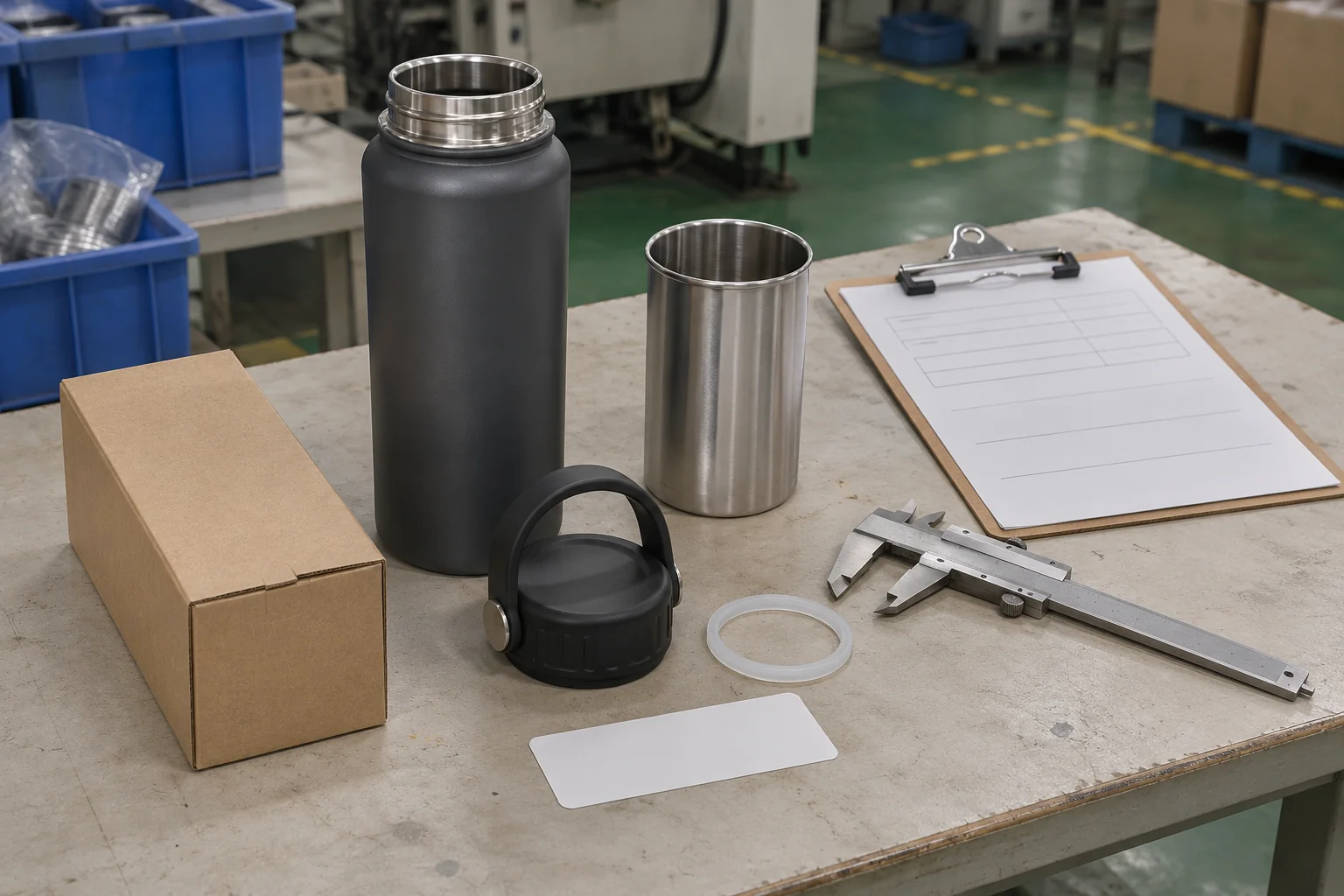
Ask for material identity evidence tied to the liner stock and a way to trace that stock to the approved sample and production lot. Ask the supplier how weld discoloration, embedded contamination and finishing residues are controlled in the specific construction.
Use material reports to review conformity to the ordered grade. Use finished vessel evidence to review how forming, joining and finishing affected the drinking surface. If a substitution is proposed, require a written change review that identifies the affected inventory, documentation and claims.
What should a test or inspection record include?
During a review of fabrication, suppose one supplier proposes a changed finishing route after the purchase order. Ask for a change record, material identification and comparable finished surfaces. Watch for this risk: an approved alloy is assumed to guarantee an unchanged drinking surface.
Keep individual observations alongside the conclusion, including the item or lot ID, who recorded the observation, the conditions, and any agreed limitation. If the method changed partway through, retain both records and note which decision each supports. This gives the buyer an audit trail for the order and a baseline for investigating disagreement at first delivery.
Set up a direct exposure comparison
Use matched finished samples with the same nominal capacity, gasket design and surface condition where feasible. Prepare the same beverage recipe for each, control storage and exposure time, and retain a plain-water baseline to help interpret results.
Agree the inspection points before starting. Capture consistent images before and after, inspect for surface changes and persistent residues, and record the cleaning steps and repeat count. Handle any material safety or migration question through a suitable lab review and relevant test scope.
When should the buyer ask for clarification?
During a review of sample comparison, suppose two flasks are exposed to different drink concentrations and stored at different temperatures. Ask for a single prepared solution, coded samples and a common exposure schedule. Watch for this risk: a procedural difference is interpreted as a grade advantage.
Treat gaps in identification or scope as questions for the person who produced the evidence. Ask them to show how the report or quotation connects to the requested decision and confirm the response with the team that owns the order. If the issue matters to a contractual requirement or a public claim, document the answer in the approval file before the release deadline.
Distinguish staining, residue and localized damage
Shadows on a brushed surface, mineral scale, dry powder and surface attack can look similar in photographs. Compare after an agreed cleaning procedure and consistent illumination. Document where the feature occurs and whether it changes after cleaning.
Inspect whether similar marks cluster beside a weld, on one bottom radius or under the gasket. That pattern can guide investigation. When a conclusion affects an order, ask for close-up evidence and expert evaluation before naming the cause to a customer.
When should the team reopen the decision?
During a review of inspection, suppose dark specks are visible only after a sample dries and cluster around an accessible crease. Ask for photographs under common lighting and inspection after a defined rinse. Watch for this risk: a removable residue is documented as corrosion before it is examined.
List the changes that could invalidate the earlier review and agree who has authority to accept them. Ask the supplier to identify already-produced stock and open purchase orders when a change is proposed. Decide whether the change calls for a targeted review or a new sample, and record which shipments can proceed during the review.
Translate the evidence into an order decision
Imagine a distributor splitting the range between trail water bottles and electrolyte-use products for endurance events. The buyer can qualify both grades using separate, realistic profiles, then compare incremental cost and the benefit of maintaining two specifications.
Freeze the chosen liner, cap and gasket together at approval. Record what triggered the choice and what evidence supported it. This makes a future cost-reduction proposal easier to evaluate because the purchasing team can reproduce the original review.
What goes into the final approval file?
During a review of release, suppose the replacement seal has the same dimensions but a revised material record. Ask for the updated component list and assessment of exposure and documentation. Watch for this risk: the production order inherits an approval that predates the substitution.
Archive the agreed specification, dated evidence and decision in one place. Include the acceptance criteria, any approved exception and the contact for future questions. When the same configuration is ordered again, confirm that the current purchase order still points to the same records. Use field feedback and receiving observations to flag criteria that should be revised for the next round.
Buyer questions
Is 316L always the best liner for outdoor bottles?
Start with the beverage, expected contact time, washing routine and finished surface. The cost of 316L may make sense for a range with more demanding exposure, while 304 remains a candidate for many water-use profiles. Compare both as finished vessels when the decision matters and let the evidence and quotation inform the specification. Ask whether the supplier is comparing two different grades at the same wall thickness and finish. Running both options across the same handling and inspection sequence gives the buyer a fairer comparison and provides a record for the next season.
What should a vendor provide to substantiate the liner description?
Request a material record for the liner stock, the supplier’s identification for that stock, and a documented connection to the sample or production lot under review. Review what the claim actually covers before approving copy. To substantiate beverage compatibility, the buyer may also need finished-article evidence under a defined use profile. Ask the vendor for a component drawing that distinguishes the outer body, the liner and the closures. That drawing can prevent copy built around a liner grade from being read as a comprehensive statement about every material in the assembly.
Why can two flasks with the same grade show different behavior?
Forming and joining, surface finish, embedded contamination, geometry and cleaning all affect the completed item. A smooth area on the barrel and a rough inaccessible area at the neck can respond very differently in use. Ask for photographs and notes from multiple sample locations under the same conditions. Ask whether returned pieces share an assembly detail, batch or pattern of exposure before inferring a cause. Where the evidence remains mixed, isolate one variable at a time. The distinction helps guide corrective action toward the finish, welding, gasket, or user care instructions that actually need attention.
Can the same corrosion trial establish food-contact compliance?
A buyer-defined comparative trial can reveal behavior under the selected conditions. Food-contact compliance evaluation has its own applicable scope, methods and documentation. Ask the responsible reviewer which finished components, material records and intended uses must be covered before making a compliance claim. If a trial finds discoloration or a reporting team receives an unexplained deposit, document the observation and seek qualified review. Avoid using a home-style exposure test as evidence about the identity or amount of substances that might migrate. Record both the relevant jurisdiction and the configuration the buyer plans to market.
How should we prepare for the first repeat order?
Confirm the approved lining material, closure and gasket against the new order. Ask whether material suppliers, forming, joining, finishing or cleanability instructions have changed since the pilot. Request a fresh evaluation for changes that affect the relevant exposure or documentation. Retain a reference sample and the previous decision records so someone new to the account can investigate early complaints. Before ordering a new color, ask whether only the exterior changed or whether a new closure or component source also entered the proposal. A revision note gives the next order a documented baseline.